Origin of cancers
Individual cells of tissues are endowed with great autonomy and versatility. Additionally, many cells retain the ability to grow and divide long after organismic development has been completed. Most types of cells carry a complete genome, “which far more information than any one of these cells will ever require”.
At the same time, this versatility and autonomy poses a grave danger, in that individual cells within the organism may gain access to information in their genome that is normally denied to them. Once their genomic sequences are subjected to corruption, the resulting mutated genes may divert cells into acquiring novel, often highly abnormal phenotypes.
Such changes may be incompatible with the normally assigned roles of these cells in organismic structure and physiology. When portrayed in this way, the renegade cells that form a tumor are the result of normal development gone awry.
Normal cells are carefully programmed to participate in constructing the diverse tissues that make possible organismic survival. Cancer cells have a quite different and more focused agenda. They appear to be motivated by only one consideration: making more copies of themselves.
Cancer is a term used for diseases in which abnormal cells divide without control and are able to invade other tissues. Cancer cells can spread to other parts of the body through the blood and lymph systems.
Cancer is not just one disease but many diseases. There are more than 100 different types of cancer. Most cancers are named for the organ or type of cell in which they start - for example, cancer that begins in the colon is called colon cancer; cancer that begins in melanocytes of the skin is called melanoma.
Cancer types can be grouped into broader categories. The main categories of cancer include:
- Carcinoma - cancer that begins in the skin or in tissues that line or cover internal organs. There are a number of subtypes of carcinoma, including adenocarcinoma, basal cell carcinoma, squamous cell carcinoma, and transitional cell carcinoma.
- Sarcoma - cancer that begins in bone, cartilage, fat, muscl blood vessels, or other connective or supportive tissue.
- Leukemia - cancer that starts in blood-forming tissue such as the bone marrow and causes large numbers of abnormal blood cells to be produced and enter the blood.
- Lymphoma and myeloma - cancers that begin in the cells of the immune system.
- Central nervous system cancers - cancers that begin in the tissues of the brain and spinal cord.
All cancers begin in cells, the body's basic unit of life. To understand cancer, it's helpful to know what happens when normal cells become cancer cells.
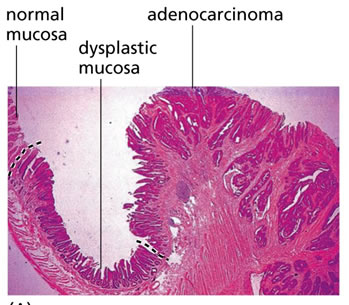
(Figure 2.1) Normal versus neoplastic tissue. This histological section of the lining of the ileum in the small intestine, reveals the continuity between normal and cancerous tissue. To the left is the normal epithelial lining, termed the mucosa. In the middle tissue has become highly abnormal, being termed “dysplastic.” To the right is as adenocarcinoma, which has begun to invade underlying tissues.
The body is made up of many types of cells. These cells grow and divide in a controlled way to produce more cells as they are needed to keep the body healthy. When cells become old or damaged, they die and are replaced with new cells.
However, sometimes this orderly process goes wrong. The genetic material (DNA) of a cell can become damaged or changed, producing mutations that affect normal cell growth and division. When this happens, cells do not die when they should and new cells form when the body does not need them. The extra cells may form a mass of tissue called a tumor.
Not all tumors are cancerous; tumors can be benign or malignancy. It is depending on their degree of aggressive growth.
- Benign tumors aren't cancerous. Those that grew locally without invading adjacent tissues were classified as benign. However, they can often be removed, and, in most cases, they do not come back. Cells in benign tumors do not spread to other parts of the body.
- The great majority of primary tumors arising in humans are benign that is harmless to their hosts, except in the rare cases where the expansion of these localized masses causes them to press on vital organs or tissues.
- Some benign tumors may cause clinical problems because release dangerously high levels of hormones that create physiologic imbalances in the body. (ex. Thyroid adenomas may cause excessive release of thyroid hormone into the circulation, leading to hyperthyroidism.
- Malignant tumors are cancerous. Cells in these tumors can invade nearby tissues and spread to other parts of the body. The spread of cancer from one part of the body to another is called metastasis.
- The vast majority of cancer-related mortality derives from malignant tumors. More specifically, it is the metastases spawned by these tumors that are responsible for some 90% of deaths from cancer.
Some cancers do not form tumors. For example, leukemia is a cancer of the bone marrow and blood.
A report from the nation's leading cancer organizations shows that rates of death in the United States from all cancers for men and women continued to fall between 2001 and 2010, the most recent reporting period available. (Read more about the Annual Report.)
Estimated new cases and deaths from cancer in the United States in 2014:
- New cases: 1,665,540 (does not include nonmelanoma skin cancers)
- Deaths: 585,720
Tumors Arise from Normal Tissues
Members of cell lineages that can traced back to the fertilized egg
1. Tumors, like normal tissues, are composed of masses of cells
2. Tumors often derive from normal tissues
Metastasis
Metastasis is a consequence of the tendency of cancers to spread throughout the body and to found new colonies of cancer cells.
Tumors have capacity to move inside the body, colonizing in other tissues. Metastasis involves the spread of cancer cells from the primary tumor to surrounding tissues and to distant organs and is the primary cause of cancer morbidity and mortality.
In order to complete the metastatic cascade, cancer cells must detach from the primary tumor, intravasate into the circulatory and lymphatic systems, evade immune attack, extravasate at distant capillary beds, and invade and proliferate in distant organs(Figure.14.3). Currently, several hypotheses have been advanced to explain the origin of cancer metastasis. These involve an epithelial mesenchymal transition, an accumulation of mutations in stem cells, a macrophage facilitation process, and a macrophage origin involving either transformation or fusion hybridization with neoplastic cells.
Many of the properties of metastatic cancer cells are also seen in normal macrophages. A macrophage origin of metastasis can also explain the long-standing "seed and soil" hypothesis and the absence of metastasis in plant cancers. The view of metastasis as a macrophage metabolic disease can provide novel insight for therapeutic management.
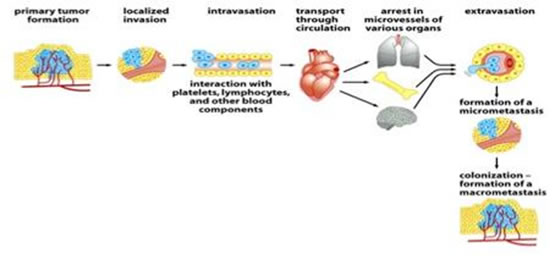
(Figure.14.3)
Cancer of unknown primary (CUP) is when a secondary cancer is diagnosed, but doctors can’t tell where the primary cancer started. Your doctors may arrange tests to try to find out where the cancer first started. But in many cases, even after these tests, the primary cancer cannot be found.
Primary cancer
A cancer is usually named after the part of the body where it first started to grow. This is known as the primary site or the primary cancer. For example, a cancer that starts in the bowel is known as a bowel cancer and a cancer that started in the lung is called a lung cancer.
Sometimes cancer cells spread to other parts of the body. They can travel through the blood or lymphatic system.
The lymphatic system is part of the immune system - the body’s natural defense against infection and disease. Lymph nodes (glands) are part of this system. They exist throughout the body and are connected together by a network of tiny tubes (ducts) that carry a fluid called lymph.
Secondary cancer
If cancer cells spread from the primary cancer to another part of the body, they may go on dividing and form a new cancer called a secondary cancer or a metastasis.
The secondary cancer is named according to the primary cancer. For example, a cancer that starts in the lungs and spreads to the liver is still a lung cancer. The secondary cancer in the liver is made up of lung cancer cells and not liver cells.
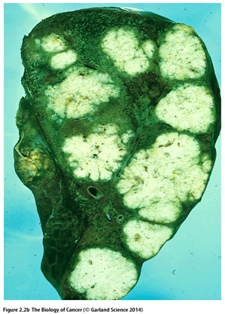 (Figure 2.2) Metastases (white) in the liver often arise in patients with advanced colon carcinomas. The portal vein, which drains blood from the colon into the liver, provides a route for metastasizing colon cancer cells to migrate directly into the liver.
Secondary cancers are also usually treated according to the primary cancer. Knowing where the cancer started helps the doctors to know what types of treatment to use for the secondary cancer. For example, a lung cancer that has spread to the liver will be treated using lung cancer treatments. It’s treated differently to a cancer that starts in the liver (primary liver cancer).
With CUP, the primary cancer isn’t known. This means that treatment choices are often more difficult to make.
Classification of cancers
Cancers are classified in two ways:
1.Classification by site of origin: by the type of tissue in which the cancer originates (histological type) and by primary site, or the location in the body where the cancer first developed. Cancers may be of specific types like breast cancer, lung cancer, prostate cancer, liver cancer renal cell carcinoma (kidney cancer), oral cancer, brain cancer etc.
2.Classification by tissue types: the international standard for the classification and nomenclature of histologies is the International Classification of Diseases for Oncology, Third Edition (ICD-O-3). This classification is based on the ICD-O-3.
From a histological standpoint there are hundreds of different cancers, which are grouped into six major categories:
- Carcinoma
- Sarcoma
- Myeloma
- Leukemia
- Lymphoma
- Mixed Types
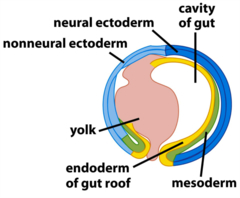 (Figure 2.5) Embryonic cell layers. Each of the three embryonic cell layers is precursor to distinct types of differentiated cells. The skin and nervous system develop from the ectoderm, while the connective tissue, including bone, muscle, and blood-forming cells, develops from the mesoderm. The epithelia of the lungs, liver, gallbladder, pancreas, esophagus, stomach, and intestines all derive from the inner cell layer, the endoderm.
Carcinoma
Carcinoma refers to a malignant neoplasm of epithelial origin or cancer of the internal or external lining of the body. Carcinomas, malignancies of epithelial tissue, account for 80 to 90 percent of all cancer cases.
Epithelial tissue is found throughout the body. Epithelia are sheets of cells that line the walls of cavities and channels. It is present in the skin, as well as the covering and lining of organs and internal passageways, such as the gastrointestinal tract.
Carcinomas usually affect organs or glands capable of secretion including breast, lungs, bladder, colon and prostate.
Carcinomas are of two types – adenocarcinoma and squamous cell carcinoma.
- Adenocarcinoma develops in an organ or gland ; squamous cell carcinoma originates in squamous epithelium
- Adenocarcinomas may affect mucus membranes and are first seen as a thickened plaque-like white mucosa. These are rapidly spreading cancers.
Histological analyses had revealed that normal tissues containing epithelia are all structured similarly. Thus, beneath the epithelial cell layers in each of these tissues lies a basement membrane; it separates the epithelial cells from the underlying layer of supporting connective tissue cells, termed the stroma.
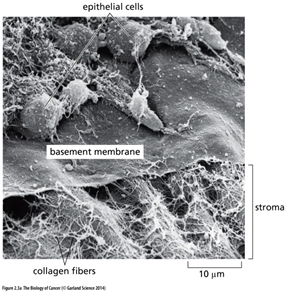
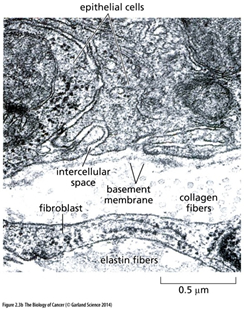
(Figure 2.3) The scanning electron micrograph of a chick corneal epithelium.
Carcinomas are divided into two major subtypes: adenocarcinoma, which develops in an organ or gland, and squamous cell carcinoma, which originates in the squamous epithelium.
Adenocarcinomas generally occur in mucus membranes and are first seen as a thickened plaque-like white mucosa. They often spread easily through the soft tissue where they occur. Squamous cell carcinomas occur in many areas of the body.
Most carcinomas affect organs or glands capable of secretion, such as the breasts, which produce milk, or the lungs, which secrete mucus, or colon or prostate or bladder.
Sarcoma
Sarcoma refers to cancer that originates in supportive and connective tissues such as bones, tendons, cartilage, muscle, and fat.
Generally occurring in young adults, the most common sarcoma often develops as a painful mass on the bone
Bone cancer is one of the sarcomas termed osteosarcoma. It affects the young most commonly.
Sarcoma tumors usually resemble the tissue in which they grow.
Examples of sarcomas are:
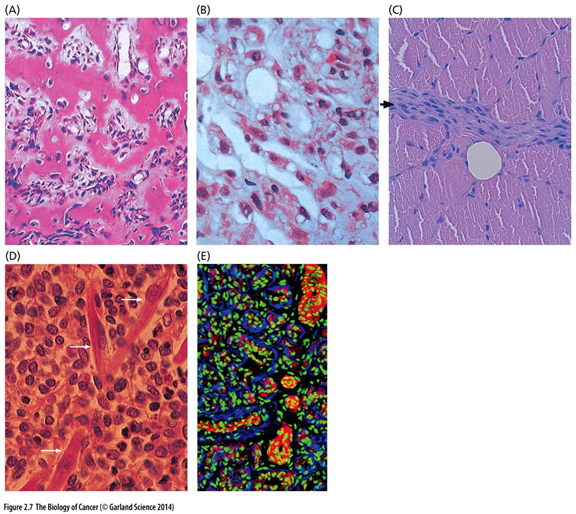
- Osteosarcoma or osteogenic sarcoma (bone) (Figure 2.7.A)
- Chondrosarcoma (of the cartilage)
- Leiomyosarcoma (smooth muscle) (Figure 2.7.C)
- Rhabdomyosarcoma (skeletal muscle) (Figure 2.7.D)
- Mesothelial sarcoma or mesothelioma (membranous lining of body cavities)
- Fibrosarcoma (fibrous tissue)
- Angiosarcoma or hemangioendothelioma (blood vessels)
- Liposarcoma (adipose or fatty tissue) (Figure 2.7.B)
- Glioma or astrocytoma (neurogenic connective tissue found in the brain)
- Myxosarcoma (primitive embryonic connective tissue)
- Mesenchymous or mixed mesodermal tumor (mixed connective tissue types)
Myeloma
Myeloma is cancer that originates in the plasma cells of bone marrow. The plasma cells produce some of the proteins found in blood. Myeloma is a type of blood cancer.
Leukemia
Leukemias ("liquid cancers" or "blood cancers") are cancers of the bone marrow (the site of blood cell production). The word leukemia means "white blood" in Greek. The disease is often associated with the overproduction of immature white blood cells. These immature white blood cells do not perform as well as they should, therefore the patient is often prone to infection. Leukemia also affects red blood cells and can cause poor blood clotting and fatigue due to anemia.
Types of leukemia include:
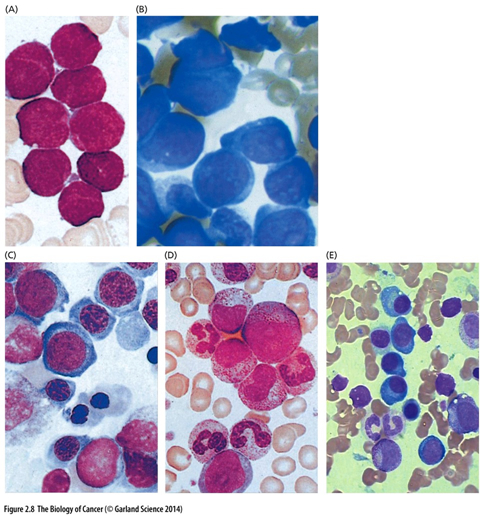
- Acute myelocytic leukemia (AML; Figure 2.8.B) – these are malignancy of the myeloid and granulocytic white blood cell series seen in childhood.
- Chronic myelocytic leukemia (CML; Figure 2.8.D) – this is seen in adulthood.
- Acute Lymphatic, lymphocytic, or lymphoblastic leukemia (ALL ; Figure 2.8.A) – these are malignancy of the lymphoid and lymphocytic blood cell series seen in childhood and young adults.
- Chronic Lymphatic, lymphocytic, or lymphoblastic leukemia (CLL) – this is seen in the elderly.
- Polycythemia vera or erythremia (Figure 2.8.C) – this is cancer of various blood cell products with a predominance of red blood cells.
Lymphoma
Lymphomas develop in the glands or nodes of the lymphatic system, a network of vessels, nodes, and organs (specifically the spleen, tonsils, and thymus) that purify bodily fluids and produce infection-fighting white blood cells, or lymphocytes. Unlike the leukemias which are sometimes called "liquid cancers," lymphomas are "solid cancers." Lymphomas may also occur in specific organs such as the stomach, breast or brain. These lymphomas are referred to as extranodal lymphomas.
These lymphomas are referred to as extranodal lymphomas. The lymphomas are subclassified into two categories: Hodgkin lymphoma and Non-Hodgkin lymphoma. The presence of Reed-Sternberg cells in Hodgkin lymphoma diagnostically distinguishes Hodgkin lymphoma from Non-Hodgkin lymphoma.
Mixed Types
The type components may be within one category or from different categories. Some examples are:
- adenosquamous carcinoma
- mixed mesodermal tumor
- carcinosarcoma
- teratocarcinoma
In the next section, you will be provided with a comprehensive list of tissue types and the tumors that arise from them.
- 1. Carcinoma-epithelia [most] [ectodermal and endodermal origin] The most common human cancers are of epithelial origin-the carcinomas (about 80%).
- 2. sarcoma-mesenchymal (1%) Sarcoma and leukemia (血癌) derived from mesodermal origin.
- 3. In human clinic, derive from various mesenchymal cell types including fibroblasts, adipocytes, osteoblasts and myocytes.
- 4. Angiosarcoma arises from the endothelial cells.
- 5. Sarcomas derive from a variety of mesenchymal.
cell types: fibroblasts (connective tissues) , adipocytes (fat), osteoblasts (bone), myocytes (muscle) - 6. Hematopoietic cancer-hematopoietic, these cancers arise from the various cell types, constituted the blood-forming (hematopoietic) tissues.
- 7. T cell and B cells, Among these are cells destined to form erythrocytes, antibody-secreting cells, as well as T and B lymphocytes.
- 8. Lymphoma– solid tumors of lymphocytes (B & T cells), most frequently found in lymph nodes leukemia – tumors of “white cells” of the blood, usually moving freely through the circulation.
- 9. Neuroectodermal cancer-neuroectodermal, Most carcinomas fall into two categories: squamous cell carcinomas arise from epithelia that form protective cell layers, while adenocarcinomas arise from secretary epithelia (cavities, or duct). Sarcomas [non-epithelial cancer], counted about 1% of the tumors encountered.